Bladder leaks, urgency, and frequent urination after a C-section are more common than people think, and more treatable than you've probably been told. Our clinicians can help you understand what's driving your symptoms and build a recovery plan that actually works.
If you gave birth by C-section and you're now dealing with bladder leaks, sudden urges to pee, or annoyingly frequent trips to the bathroom, you may be confused. After all, a cesarean is supposed to protect your pelvic floor from incontinence postpartum, right?
Wrong. Or rather, sort of wrong.
Compared to vaginal delivery, C-sections offer a degree of protection against postpartum urinary incontinence and related bladder symptoms…but they don’t bring the risk to zero. Symptoms of bladder urgency, frequency, and leaking after c-section are more common than most people realize.
Even though they’re somewhat common, you don’t have to “just live with” these problems. We’re here to help you understand why bladder problems happen after C-sections and what you can do to address them. (Spoiler alert: pelvic floor physical therapy can help a ton!)
Does having a C-section prevent postpartum urinary incontinence?
Not entirely. Delivery by C-section, both planned and unplanned, does reduce the likelihood of certain types of urinary incontinence, but a lower risk is not the same as no risk. Here’s what the research shows us:
- Compared to vaginal delivery, cesarean delivery is associated with roughly half the odds of developing urinary incontinence.
- The risk of leaking after C-section varies depending on the type of leakage you’re considering. Compared to those who delivery vaginally, people who have C-sections:
- Have an 8% lower risk of stress urinary incontinence (think: leaks when you laugh, sneeze, jump)
- Have a 3% lower risk of urge urinary incontinence (think: leaks that happen because you “gotta go right now” but can’t make it to the toilet in time)
These data reveal two important points:
- Even with a C-section delivery, the risk of incontinence postpartum still isn’t zero.
- While C-section may reduce the odds that you’ll leak when you run or cough, your risk of urinary urgency and other bladder symptoms is much closer to that seen in people who deliver vaginally.
To understand leaking, urgency, and frequent urination after C-section, we must look beyond the delivery itself to consider the other factors in play.
How can a C-section still make me incontinent after birth?
Pregnancy and delivery (regardless of mode) are major physical events that challenge your pelvic floor and internal organs, including the urinary system. Three major mechanisms contribute to leaking after C-section:
- The physical load of pregnancy taxes your pelvic floor muscles.
- Cesarean surgery really stresses your bladder and the tissues surrounding it.
- Post-operative scar tissue restricts mobility, blood flow, and nerve communication to your bladder.
Any combination of these mechanisms can contribute to postpartum urinary incontinence and related symptoms. Let’s break it down.
Pregnancy loads your pelvic floor regardless of how you deliver
You can probably appreciate how vaginal birth can lead to urinary incontinence after childbirth. Pushing a baby through the birth canal puts significant strain on the pelvic floor muscles and the surrounding tissues, and they need time to recover.
However, many people fail to consider how pregnancy itself stresses these tissues long before one’s delivery date. Throughout pregnancy, the pelvic floor muscles support increasing downward pressure as your baby grows and body weight increases.
The pelvic muscles and connective tissue must stretch to accommodate this pressure. Regardless of your delivery method, your pelvic floor muscles, and structures such as your urethra, are stretched and strained by pregnancy.
For people who labor for some time before an unplanned C-section, there’s an additional layer to consider. The act of laboring and pushing loads the pelvic floor muscles significantly and puts sustained pressure on the internal organs. By the time you’re in surgery for a C-section, your pelvic floor has already been working overtime.
What happens to the bladder during a C-section surgery
The bladder sits directly in front of the uterus. To access your uterus and deliver your baby, your surgeon must physically move your bladder out of the way. This displacement creates mechanical stress on the bladder and the connective tissues that support it.
In rare cases, C-section surgery may injure the bladder wall or the ureters (the tubes that carry urine from the kidneys to the bladder). The rate of bladder injury during C-section is quite low, at around 0.3%. The risk is slightly higher when a C-section happens later in labor. The frequency of bladder injury is also higher in people who have had a previous C-section and already have abdominal adhesions present.
While direct injuries are quite uncommon, they may cause ongoing bladder symptoms if they aren’t fully repaired. This is why working with a postpartum recovery specialist, like one of our clinicians at Origin, can be so powerful. Your pelvic health provider can help you understand when to expect symptom improvement and if it’s important to seek additional workup for possible undetected problems.
How C-section scar tissue contributes to bladder symptoms
Even without a direct injury to the bladder, C-section surgery creates conditions that can lead to bladder problems over time. This is where scar tissue and C-section bladder adhesions come into play.
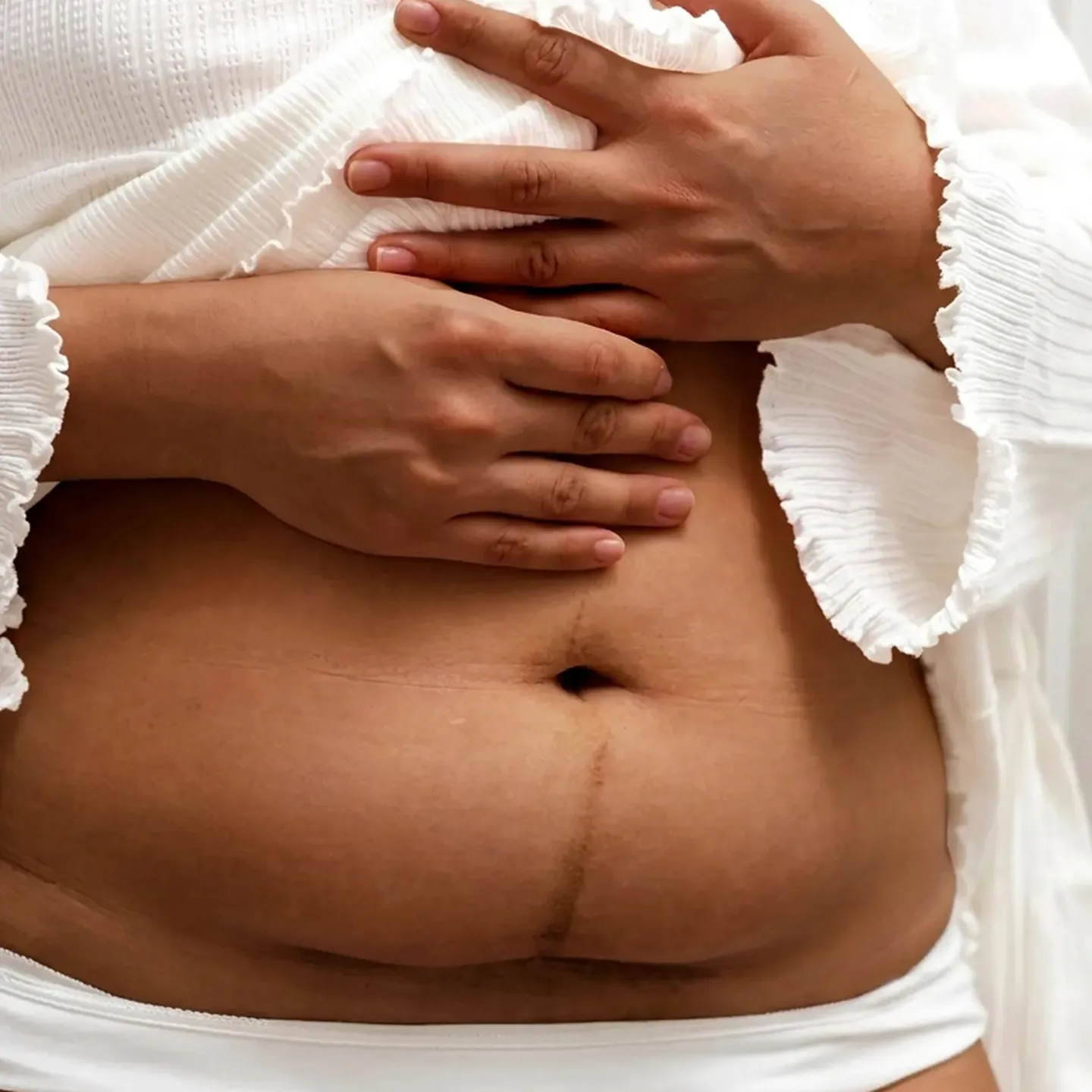
A C-section incision cuts through multiple layers of tissue: skin, fat, muscle, the peritoneum (the thin membrane lining the abdominal cavity and surrounding the organs), and the uterus. As these layers heal, scar tissue forms.
Although we only see the surface, scar tissue goes way beyond skin-deep. C-section scar tissue is continuous from the surface of your skin to the deep visceral structures: the internal organs and the connective tissue that surrounds them.
The organs of your pelvis and abdomen, including your bladder, uterus, and intestines, are not fixed in place. They move constantly, shifting as you breathe and move through your day. For example, your bladder adjusts as you bend or twist, and the small intestine glides over the top of it.
All of this movement is possible because the organs are surrounded by specialized membranes that allow them to glide against one another and against the abdominal walls. Complex connective tissue called visceral fascia helps hold them in place even as they shift with activity.
When adhesions form in the wake of surgery, they can restrict this delicate balance of glide and stability. A bladder that cannot move freely is a bladder under stress, and that stress can show up as urgency, frequency, or incontinence postpartum.
The nerves, blood vessels, and lymphatic vessels that supply the bladder also run through your visceral fascia. Restrictions in this fascia can affect bladder function by disrupting its blood flow and nerve communication, which can further aggravate your symptoms.
How can pelvic floor physical therapy help with bladder symptoms after a C-section?
Because multiple factors contribute to bladder symptoms after C-section, addressing them effectively requires a multifaceted approach to care. Pelvic floor physical therapy offers exactly that.
At Origin, your provider may incorporate scar tissue mobilization, pelvic floor and abdominal muscle training, and a combination of other treatment strategies to help you tackle urinary incontinence after childbirth and other post-cesarean symptoms.
Scar tissue work and fascial mobilization
A pelvic floor physical therapist can assess and treat problems with C-section scar mobility. Scar tissue work addresses the restricted gliding between the abdominal wall, bladder, uterus, and surrounding tissues that can develop as scar tissue matures.
Scar tissue mobilization is not a cosmetic or aesthetic treatment. By improving scar mobility, you’ll be improving the ability of your pelvic organs to move and glide normally. Your pelvic floor physical therapist may even teach you how to perform scar massage at home, to extend the benefits of treatment between in-clinic visits.
Visceral fascial mobilization is an advanced technique that some providers can offer to help facilitate better gliding between the organs and their fascial “wrappings”. For people with C-section bladder adhesions or other deeper adhesions, these techniques may be helpful additions to the postpartum care plan.
In addition to these hands-on techniques, targeted stretches and general exercise can improve mobility and increase blood flow to the abdominal tissues. Your pelvic floor physical therapist will help you prioritize tight tissues with safe, comfortable stretches and guide you in returning to exercise after C-section.
Pelvic floor muscle training
While scar tissue work tackles the problem from above, strengthening and coordinating the pelvic floor muscles helps regulate bladder behavior from below. As we’ve discussed, pregnancy (and any time you spent in labor) stressed your pelvic floor, so it will need help to recover fully.
When properly prescribed, pelvic floor muscle training can help address both the urgency and stress components of urinary incontinence after childbirth. Pelvic floor exercises should focus on coordination, strength, and endurance: it’s way more than “just doing your kegels”!
Why combining treatment approaches matters
No single mechanism causes leaking, urgency, or frequent urination after C-section, so no single treatment is likely to fully resolve them. The combination of scar tissue work, fascial mobilization, pelvic floor muscle training, and full body exercise tackles these problems from multiple angles.
By addressing adhesions and visceral mobility alongside muscle function, you can address all contributions simultaneously and start feeling better, sooner.
You deserve a full recovery from C-section delivery
Bladder symptoms after a C-section are real and common, but they aren’t something you simply have to accept. Having a cesarean doesn’t mean you bypass pelvic floor rehab: it just means your recovery may look a little different from your peers who delivered vaginally.
If you are experiencing bladder urgency, incontinence, or frequent urination after C-section, our expert Origin clinicians are here to help. Schedule your first visit today to learn what’s driving your symptoms and get a treatment plan tailored to your needs.
- Chill, Henry H et al. "Urinary bladder injury during cesarean delivery: risk factors and the role of retrograde bladder filling." International urogynecology journal vol. 32,7 (2021): 1801-1806. doi:10.1007/s00192-020-04630-9
- Horton, Ramona C. "The Anatomy, Biological Plausibility and Efficacy of Visceral Mobilization in the Treatment of Pelvic Floor Dysfunction." Journal of Pelvic, Obstetric and Gynaecological Physiotherapy, vol. 117, 2015, pp. 5–18
- Keag, Oonagh E et al. "Long-term risks and benefits associated with cesarean delivery for mother, baby, and subsequent pregnancies: Systematic review and meta-analysis." PLoS medicine vol. 15,1 e1002494. 23 Jan. 2018, doi:10.1371/journal.pmed.1002494
- Tähtinen, Riikka M et al. "Long-term Impact of Mode of Delivery on Stress Urinary Incontinence and Urgency Urinary Incontinence: A Systematic Review and Meta-analysis." European urology vol. 70,1 (2016): 148-158. doi:10.1016/j.eururo.2016.01.037
- Tarney, Christopher M. "Bladder Injury During Cesarean Delivery." Current women's health reviews vol. 9,2 (2013): 70-76. doi:10.2174/157340480902140102151729
- Safrai, Myriam et al. "Urinary tract injuries during cesarean delivery: long-term outcome and management." The journal of maternal-fetal & neonatal medicine : the official journal of the European Association of Perinatal Medicine, the Federation of Asia and Oceania Perinatal Societies, the International Society of Perinatal Obstetricians vol. 35,18 (2022): 3547-3554. doi:10.1080/14767058.2020.1828336
- Shek, Ka Lai et al. "The effect of pregnancy on hiatal dimensions and urethral mobility: an observational study." International urogynecology journal vol. 23,11 (2012): 1561-7. doi:10.1007/s00192-012-1795-y