
If you feel like you’re getting more frequent urinary tract infections (UTIs) after menopause, you’re not imagining it. The internet is full of quick fixes, from cranberry juice to probiotics, and plenty of people saying it’s “just a part of getting older”. While some (but certainly not all) of this can be helpful information, we’ll discuss the science behind recurring UTIs in menopause, including the role of estrogen, and give you an evidence-based path forward.
What can cause frequent UTIs after menopause
First, let’s discuss the role of estrogen. Estrogen is a hormone made primarily in the ovaries that helps to:
- Support a healthy vaginal microbiome, the healthy bacterial "environment". A healthy microbiome makes the vagina slightly acidic (think lemon juice), helping shield against infection
- Maintain strength and moisture of the vulva and vaginal tissue
- Maintain and increase muscle strength, especially at the pelvic floor muscles
- Coordinate the bladder and the urethral sphincter, an involuntary muscle that helps you empty your bladder
When estrogen levels drop after menopause:
- Vaginal pH shifts from acidic to alkaline (think baking soda), which can lead to growth of less-friendly bacteria, including UTI-causing bacteria
- Tissue becomes thinner, drier and more fragile, which may allow bacteria an easier path to the bladder
- Pelvic floor muscles weaken and may not coordinate or relax effectively
- The urethra doesn’t seal as well and it becomes harder to completely empty your bladder
How to recognize a recurrent UTI
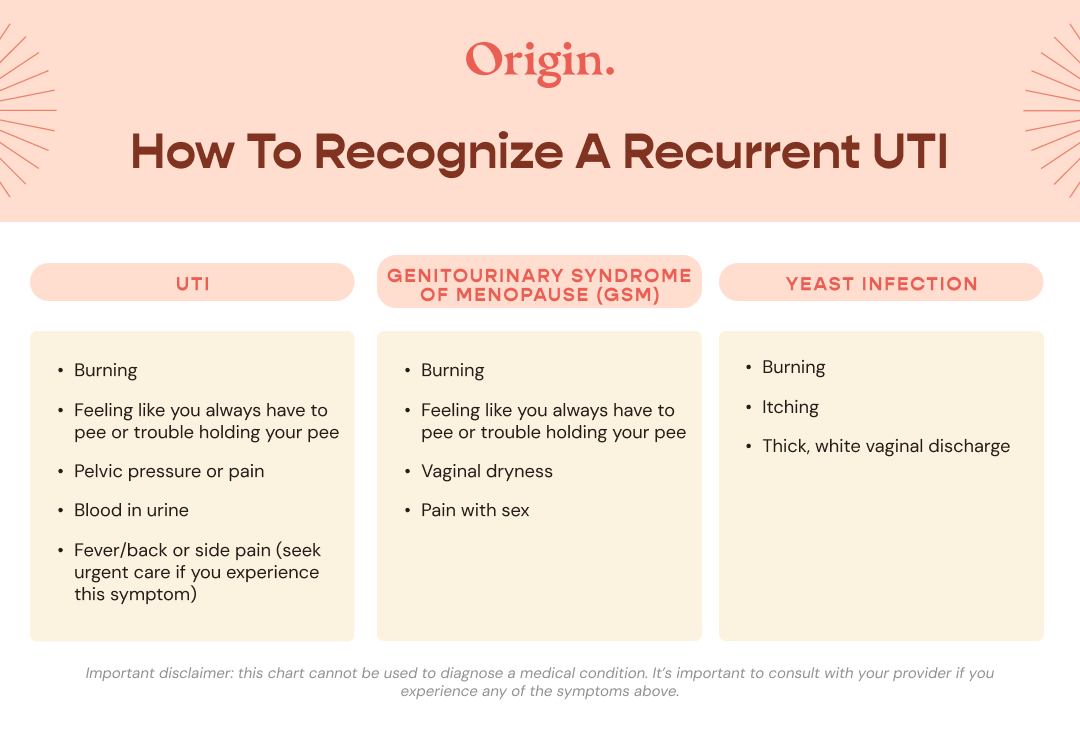
It can be challenging to spot a UTI and to know if it’s just a one-off or a pattern. Doctors call a UTI “recurrent” if you’ve had 3 UTIs in 6 months or 3 in a year. In addition, below is a chart that should make it a little easier to understand your symptoms and differentiate them from other conditions that might present similarly. We’ll focus specifically on UTI, genitourinary syndrome of menopause (GSM), and yeast infection.
Why antibiotics alone are not enough
Often, antibiotics are the first line of defense for UTIs. While they can help treat an acute UTI, they do not address the underlying cause in recurrent UTIs (in menopause or any other time of life). In fact, antibiotics can contribute to the cycle of recurring UTIs. Antibiotics disrupt the vaginal microbiome leading to higher risk of a yeast infection. A yeast infection disrupts the balance of healthy bacteria, increasing the susceptibility of UTI-causing bacteria to grow, leading to another UTI and a painful cycle.
Fortunately, care is evolving. Current evidence and guidelines emphasize the importance of appropriate UTI testing and, when it’s safe, starting antibiotic treatment after test results confirm a UTI. This helps prevent the cycle of recurrent UTIs. Let’s discuss some other treatment options that help stop the cycle.
Popular treatment options for recurring UTIs: do they really help?
Vaginal estrogen
The American Urological Association recommends vaginal estrogen, usually in a cream, tablet, or ring form, as the first-line prevention for recurrent UTIs postmenopause. Benefits usually build over a few weeks and last with continued use. It’s important to discuss vaginal estrogen with your healthcare provider to determine if it’s right for you, especially if you’ve had certain forms of cancer, such as breast, uterine, or ovarian cancer. According to recent studies, these forms of cancers do not exclude you from taking vaginal estrogen, therefore it’s important to find a provider who understands menopause care.
Probiotics
The evidence for probiotics is promising but mixed. Some studies show that probiotics, especially those in suppository form, can help increase the amount of healthy bacteria which can lower the vaginal pH and help rebuild a protective barrier against UTI-causing bacteria.
It’s best to think of probiotics as a complement to vaginal estrogen, but not the replacement. If you do try probiotics, make sure to choose a reputable brand that has been third-party tested and/or USP certified, and give it 8-12 weeks to see if your symptoms improve. If not, be sure to discuss with your healthcare provider.
D-mannose
D-mannose is another supplement you might’ve heard of. It is a simple sugar found in small amounts of fruit; as a supplement, it’s usually sold in pill or powder form. The idea is that it may block UTI-causing bacteria from sticking to the bladder wall so the bacteria is flushed out when you pee.
However, in a 2024 study, D-mannose did not help prevent UTIs when compared to another sugar powder. Therefore, it’s best not to rely on this as your main prevention tool.
Hydration
While hydration alone might not prevent UTIs, it's important for overall bladder health. Maintaining adequate hydration dilutes the urine and helps avoid irritating the bladder, preventing bladder urgency or frequency. According to a 2023 study, women should aim for 2.7 L (91 oz) of water intake daily. Of course, this requirement varies with your activity level, so increase water intake if you’re exercising or sweating.
Pelvic floor physical therapy
Like we mentioned earlier, the reduction in estrogen due to menopause can cause the pelvic floor muscles to weaken or become uncoordinated. This can lead to difficulty starting your stream or incomplete bladder emptying. Normally, we flush out bacteria when we pee. However, if we have a hard time emptying our bladder or can’t empty it all the way, this can create a breeding ground for bacteria, which can increase the risk of another infection.
Pelvic floor physical therapy can target the mechanical issues that may increase your risk of a UTI. A pelvic floor physical therapist can assess how well your muscles relax and contract, use hands-on strategies to release tight muscles, and give you personalized strategies to facilitate complete emptying. Over time, you may notice more complete emptying, an easier time peeing (and holding your pee), and fewer infections.
When to seek help and what to expect
If you’ve had 3 UTIs in 6 months or 3 in a year, the standard for a “recurrent UTI”, it’s time to see a clinician. Beyond the immediate discomfort of a UTI, repeat infections can make bacteria harder to treat, and if untreated for too long, they can spread higher into the kidneys. Recurrent infections can also negatively affect your sleep, sex life, and daily routine.
You can expect your provider to confirm a true infection with urine testing, ask you about symptoms or perform an examination to assess for menopause related changes, like genitourinary syndrome of menopause (GSM), and maybe do a quick bladder scan using an ultrasound on your belly to see how well you’re emptying your bladder.
The most effective approach pairs gynecologic care with pelvic floor physical therapy. Your OB-GYN can prescribe medications to treat existing infections and possibly vaginal estrogen to help manage the hormonal contributors. Your pelvic floor PT works on the mechanics, helping you relax and coordinate the pelvic floor and empty your bladder more completely.
Origin's clinicians treat pelvic floor and urinary symptoms together as part of whole-body pelvic health care. If you’re stuck in the UTI loop, our team can help you break the cycle. Make an appointment today to start feeling better faster.
- Aggarwal, Nishant, and Stephen W. Leslie. "Recurrent Urinary Tract Infections." PubMed, StatPearls Publishing, 20 Jan. 2025, www.ncbi.nlm.nih.gov/books/NBK557479
- Baimakhanova, Baiken, et al. "Understanding the Burden and Management of Urinary Tract Infections in Women." Diseases (Basel, Switzerland), vol. 13, no. 2, Autumn 2025, p. 59, pubmed.ncbi.nlm.nih.gov/39997066/, https://doi.org/10.3390/diseases13020059
- Cooper, Tess E., et al. "D-Mannose for Preventing and Treating Urinary Tract Infections." The Cochrane Database of Systematic Reviews, vol. 8, no. 8, 30 Aug. 2022, p. CD013608, pubmed.ncbi.nlm.nih.gov/36041061/, https://doi.org/10.1002/14651858.CD013608.pub2
- Gupta, Varsha, et al. "Effectiveness of Prophylactic Oral And/or Vaginal Probiotic Supplementation in the Prevention of Recurrent Urinary Tract Infections: A Randomized, Double-Blind, Placebo-Controlled Trial." Clinical Infectious Diseases: An Official Publication of the Infectious Diseases Society of America, vol. 78, no. 5, 12 Dec. 2023, p. ciad766, pubmed.ncbi.nlm.nih.gov/38084984/#:~:text=Probiotic%20supplementations%20were%20well%20tolerated, https://doi.org/10.1093/cid/ciad766
- Hayward, Gail, et al. "D-Mannose for Prevention of Recurrent Urinary Tract Infection among Women: A Randomized Clinical Trial." JAMA Internal Medicine, vol. 184, no. 6, 8 Apr. 2024, jamanetwork.com/journals/jamainternalmedicine/article-abstract/2817488, https://doi.org/10.1001/jamainternmed.2024.0264
- North American Menopause Society. "The 2022 Hormone Therapy Position Statement of the North American Menopause Society." Menopause (New York, N.Y.), vol. 29, no. 7, 1 July 2022, pp. 767–794, pubmed.ncbi.nlm.nih.gov/35797481/, https://doi.org/10.1097/GME.0000000000002028
- Pagar, Roshani, et al. "The Microbial Revolution: Unveiling the Benefits of Vaginal Probiotics and Prebiotics." Microbiological Research, vol. 286, 31 May 2024, p. 127787, www.sciencedirect.com/science/article/pii/S0944501324001885, https://doi.org/10.1016/j.micres.2024.127787. Accessed 31 May, 2024
- Robinson, Dudley. "Oestrogens and Lower Urinary Tract Dysfunction Chronicling a Lifetime of Research." Continence, vol. 12, no. 12, 17 Oct. 2024, p. 101720, www.sciencedirect.com/science/article/pii/S2772973724009950, https://doi.org/10.1016/j.cont.2024.101720
- Seal, Adam D., et al. "Total Water Intake Guidelines Are Sufficient for Optimal Hydration in United States Adults." European Journal of Nutrition, vol. 62, no. 1, 9 Aug. 2022, https://doi.org/10.1007/s00394-022-02972-2
- Tan-Kim, Jasmine, et al. "Efficacy of Vaginal Estrogen for Recurrent Urinary Tract Infection Prevention in Hypoestrogenic Women." American Journal of Obstetrics and Gynecology, vol. 229, no. 2, 1 Aug. 2023, pp. 143.e1–143.e9, pubmed.ncbi.nlm.nih.gov/37178856/, https://doi.org/10.1016/j.ajog.2023.05.002