A tight pelvic floor may not be obvious. You may notice pelvic or back pain, constipation, or difficulty peeing (or the opposite, feeling like you always have to pee). While we’re getting better at spotting weakness at the pelvic floor, many of us overlook the opposite issue - a tight pelvic floor. With a few simple pelvic floor stretches and breathing exercises, you can begin to ease that tension today, finding real relief from bothersome symptoms.
What is the pelvic floor?
Your pelvic floor is a group of layered muscles and connective tissue that form a supportive “hammock” at the base of your pelvis. These muscles run from your pubic bone in the front to your sacrum in the back.
When these muscles are strong and coordinated, they help you:
- Control bladder and bowel function
- Support everyday movement
- Enjoy pain-free intercourse
- And much more!
Signs of a tight pelvic floor
Your pelvic floor muscles are just like any other muscle in the body. When you’re stressed at work, your shoulder may tense or when you skip your post-run stretch your hamstrings may feel hamstrings tight. In the same way, pelvic floor muscles that are chronically tense due to overuse, injury, or stress, can cause pain and functional issues.
Here are some common warning signs of a tight pelvic floor:
- Difficulty starting the flow of urine
- Pain when you pee
- Pain with sex
- Low back, pelvic, or tailbone pain
- Urinary leakage when jumping, coughing, or sneezing
- Constipation
You’re not alone if you’re experiencing any of these symptoms, but you don’t have to live with them. While pelvic floor tension can contribute to the symptoms above, other conditions may produce the same complaints. Let your healthcare provider know what's happening with your body so they can figure out the underlying cause of your symptoms. In the meantime, let’s talk about some ways you can start to relieve tension in the pelvic floor.
How can I relax tight pelvic floor muscles?
Think of your pelvic floor as a part of an orchestra:
- Your pelvic floor is the percussion section, keeping a steady beat as the foundation.
- Your diaphragm (your breathing muscle) is the conductor, setting the tempo.
- Your hip muscles are the strings, fine-tuning the overall sound.
If the conductor loses the rhythm or the strings slip out of tune, percussion can’t keep its groove. Similarly, shallow breathing and tight, weak hips throw off the foundation of your pelvic floor muscles.
This is where deep breathing exercises and gentle hip stretches come in. They work to bring every “musician” back in sync, lengthening pelvic floor muscles and easing tension.
Using belly breaths to soften a tense pelvic floor
Diaphragmatic breathing (AKA belly breathing) is a great way to invite relaxation to a tight pelvic floor. Every time you inhale, your diaphragm contracts and moves downward. In response, your pelvic floor muscles naturally lengthen downward, allowing these muscles to stretch. Belly breathing can also encourage our parasympathetic nervous system, the rest and digest response, which can help even more with muscle relaxation.
Here’s what you can do to get some deep, belly breaths:
- Find a comfortable position, either laying on your back or sitting up in a comfortable chair
- Place one hand at your chest and one at your belly
- Close your eyes and inhale through your nose, feeling the hand on your belly rise
- Next, see if you can bring attention to the pelvic floor muscles. As you breathe in, you may notice your pelvic floor soften or move downward
- Exhale through your mouth, allowing your belly to relax
Practice 10-20 minutes each day and you’ll start to feel tension at the pelvic floor letting go.
How can stretching ease pelvic floor tension?
As we discussed, the pelvic floor is a group of layered muscles and connective tissue that form a supportive "hammock" at the base of your pelvis — and that hammock analogy is a helpful one here too. Imagine you’re setting up your hammock and it is too short to reach between two palm trees. The hammock is pulled tight, giving it little flexibility or comfort. Your pelvic floor can feel the same way as the hammock. Additionally, for some people, tight hip muscles can act like ropes pulling the trees farther apart, adding to tension to an already tight pelvic floor.
5 pelvic floor stretches you can do at home
Ready for relief? With a few simple pelvic stretches listed below, you can soften and relax an overactive pelvic floor. Want a two-for-one? Pair these moves with belly breathing to get even more relaxation.
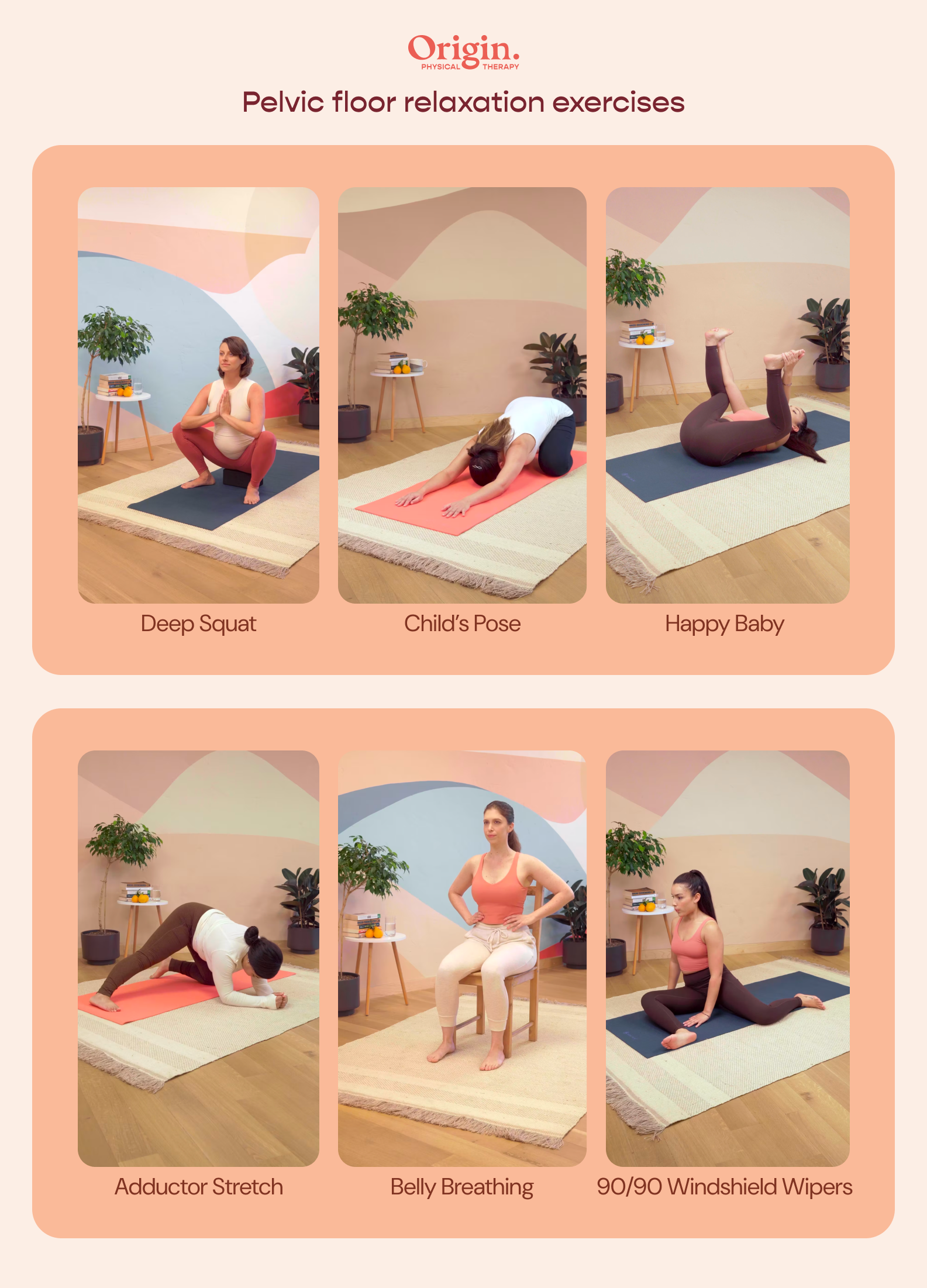
Happy baby
- Lie on your back with both knees bent. Your feet should be flat on the floor and hip distance apart
- Bring both knees to your chest and grab your heels and the outer edges of your feet with both hands
- Allow your legs to fall away from each other and out to the side
- Use your hands to guide your feet up and out, with knees pointing towards your armpits
- Hold this position for 30-60 seconds and breathe deeply
Child’s pose
- Start on your hands and knees with hands under shoulders and knees under hips
- Separate your knees so they are slightly wider than hip distance apart. Your feet may come together so your legs are in a V shape
- Sit back on your heels, using pillows in between your butt and heels if you experience any discomfort at your knees, and stretch your arms in front of you
- Hold this position for 30-60 seconds and breathe deeply
Deep squat
- Stand with your feet hip distance apart and toes angled slightly outward
- Lower deep into a squat, allowing knees to rotate outward and away from your center
- For more stability, add a yoga block or pillows under your hips or hold onto a stable surface like a door
- Hold this position for 30-60 seconds and breathe deeply
Adductor stretch
- Start on hands and knees with hands under your shoulders and knees under your hips
- Stretch one leg directly out to the side with toes pointed forward and foot flat on the floor
- Slowly lower yourself onto your forearms
- Gently sit your hips back towards your heels until you feel a stretch on the inner thigh of your extended leg (note: your hips probably won’t touch your back heel, and that’s totally fine!)
- Hold this position for 30-60 seconds and breathe deeply
90/90 windshield wipers
- Sit on the ground with your hands resting on the floor behind you and knees bent and hip distance apart
- In a slow, controlled motion, allow both knees to fall to one side
- When you are unable to drop your legs any further without moving your pelvis, return to center
- Repeat this motion in the opposite direction
- Keep chest open and a neutral spine, with no arch or rounding of your back
- Repeat 30-60 seconds, moving slowly and breathe deeply
You don’t have to live with a tight pelvic floor forever. By incorporating these simple pelvic floor stretches and relaxing belly breathing, you can start finding relief from irritating symptoms such as pain, urgency, and constipation.
If you feel stuck or are experiencing symptoms that won’t go away, a pelvic floor physical therapist can work with you to create a personalized treatment plan to relax tight muscles and give you strategies to restore balance at the pelvic floor.
Ready to relax your tight pelvic floor muscles and feel relief? Book your first visit today!
- Hamasaki, Hidetaka. "Effects of Diaphragmatic Breathing on Health: A Narrative Review." Medicines (Basel, Switzerland), vol. 7, no. 10, 15 Oct. 2020, article 65, doi:10.3390/medicines7100065
- Warneke, Konstantin, et al. "Practical Recommendations on Stretching Exercise: A Delphi Consensus Statement of International Research Experts." Journal of Sport and Health Science, vol. 14, 2025, article 101067, doi:10.1016/j.jshs.2025.101067
- Magnon, Vincent, et al. "Benefits from One Session of Deep and Slow Breathing on Vagal Tone and Anxiety in Young and Older Adults." Scientific Reports, vol. 11, no. 1, 29 Sept. 2021, article 19267, doi:10.1038/s41598-021-98736-9