If you've spent years trying to get answers about pelvic pain, chronic bloating, painful sex, or any of the many symptoms that can accompany endometriosis, you know how exhausting it feels to not be believed.
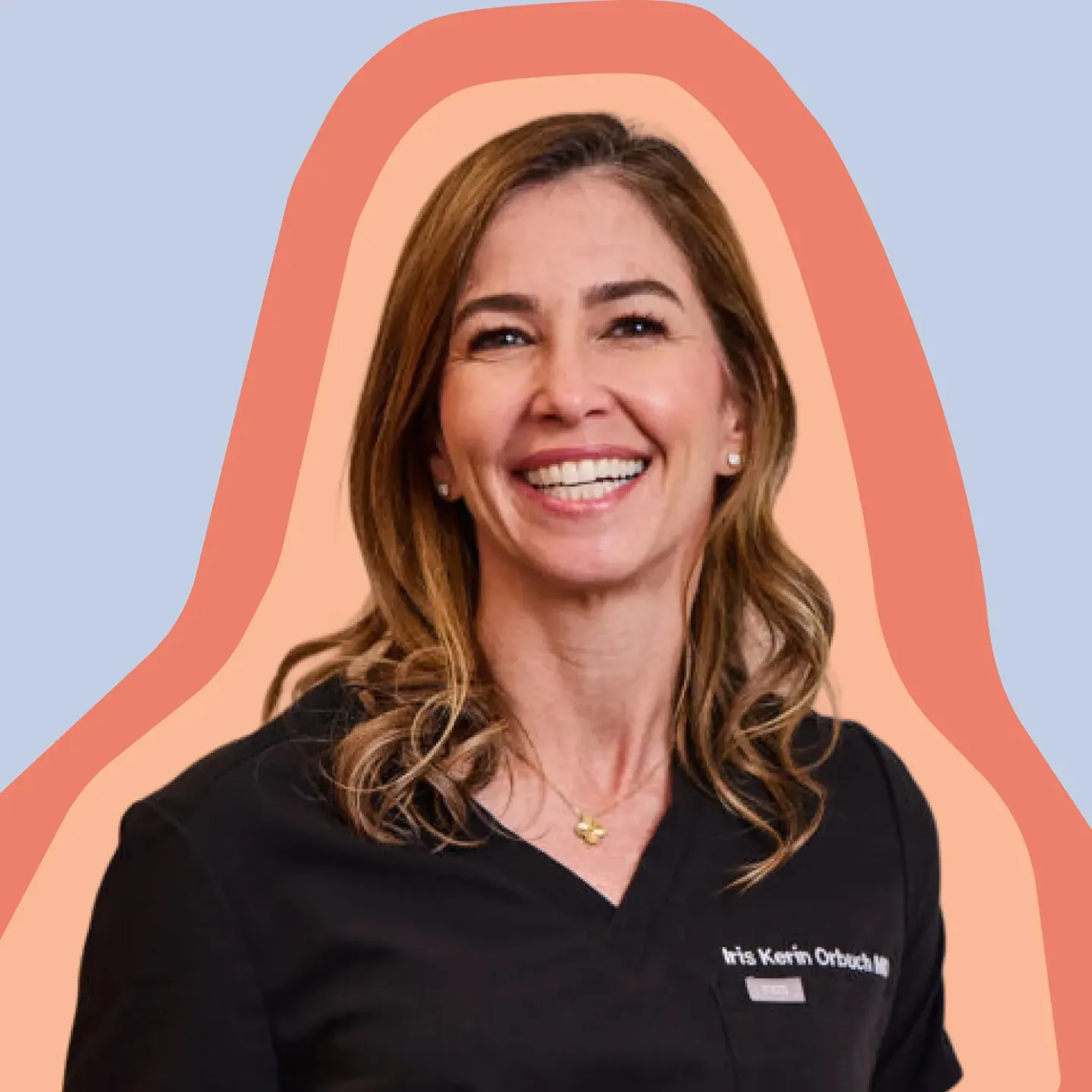
Dr. Iris Kerin Orbuch has spent her career on the other side of that equation, making sure patients are. She's dedicated her work to closing the gap between the women who are suffering and the care that can actually help them — and now she's building something to do it at scale. We asked her about what led her to this work, what needs to change in how medicine approaches pelvic pain, and what she's building next.
1. What led you to this career?
From a young age, I knew being a doctor was my calling. I went on rounds with my father, a compassionate cardiologist, on weekends. I saw firsthand what it meant to make a difference in someone's life, and I witnessed the beautiful connection he had with his patients. He treated them like family, with a heart of gold. He was my professional role model.
During my Ob/Gyn residency, the first time I walked into the operating room and saw Minimally Invasive Gynecology Surgery, I knew it was my calling. I'm grateful to my fellowship preceptors, Dr. Harry Reich and Dr. C.Y. Liu, both pioneers in endometriosis, who taught me everything they knew. I fell in love with the field.
Even though my fellowship was in Minimally Invasive Surgery, I always knew the way to heal my patients was to approach endometriosis as an inflammatory disease that needed to be surgically excised, while treating the whole body and the whole person. Excision is the cornerstone of treatment. But given the nearly decade-long diagnostic delay most patients face, I knew an East-meets-West, multidisciplinary approach was what would allow my patients to beat endometriosis. Hence, the title of my book, Beating Endo: How to Reclaim Your Life from Endometriosis.
2. For someone who has been living with chronic pelvic pain and isn't sure where to turn, what would you want them to know? What are the signs that it's time to seek out a specialist?
I would tell anyone living with chronic pain to believe their pain. Seek multiple opinions until you find a clinician who believes it too. At Iris Wings Sanctuary for Endometriosis Surgery and Wellness, we believe your pain. Our sanctuary was created as a healing space where patients are seen, heard, and treated by endometriosis experts. I highly recommend my book, Beating Endo: How to Reclaim Your Life from Endometriosis, and Shannon Cohn's films Endo What? and Below the Belt.
Endometriosis is so much more than a menstrual disorder. That is outdated thinking. It affects the whole body.
Signs that should lead you to an endometriosis specialist: painful periods, pelvic pain at any time of the month, painful sex (on entry or with deeper penetration), infertility, constipation, diarrhea, bloating, painful bowel movements, a diagnosis of irritable bowel syndrome, and urinary issues like urgency or painful urination.
3. Conditions like endometriosis and interstitial cystitis are incredibly common, yet women often wait years for a diagnosis. What needs to change in how medicine approaches these conditions and pelvic pain more broadly?
In medicine, we're taught to look at each patient through a narrow lens. A gynecologist thinks only of the female pelvic organs. A gastroenterologist, only of the intestines. A dermatologist, only of the skin. Medicine needs to be taught from a whole-body, whole-person approach rather than an organ-specific one. That's part of why I'm building Forela, to bring that view into care, not just into specialty clinics like mine.
4. Pelvic pain is still widely dismissed or minimized, even by clinicians. What's your response when patients tell you they were told their pain was "just stress” or "just in their head?"
It breaks my heart when I hear this. And I hear it numerous times a day. I want every patient to trust her intuition, trust her gut, and trust that if she doesn't feel well, the answers are there to be found.
Believe your pain. Believe your symptoms. I believe you.
At Iris Wings Sanctuary for Endometriosis Surgery and Wellness, WE BELIEVE YOU.
5. You've talked about endometriosis as an inflammatory, whole-body condition, not just a gynecologic one. Can you explain what that means for how treatment needs to be approached?
Endometriosis is an inflammatory, whole-body condition, not a menstrual disorder. Inflammatory cells of endometriosis have been identified in fetal autopsies, which tells us they are present from birth. That means years, often decades, of inflammation that can affect every organ system. It affects the gut, causing leaky gut in both the small and large intestines, along with a long list of other gut symptoms. It affects the endocrine system and increases the likelihood of autoimmune disease. It can touch every organ system, and that's why we have to treat the whole body. Excision of endometriosis is the cornerstone of treatment, and that's our specialty at Iris Wings Sanctuary. Excision surgery plus a multidisciplinary, East-meets-West approach is the way to beat endo.
6. What's the piece of advice from your book, Beating Endo, that you find yourself repeating most often to patients?
Trust yourself. Trust yourself. Believe your pain. Believe your pain.
7. Since the book came out, has anything surprised you about how readers have used it or responded to it?
Most patients say, "Thank you. Your book validated me. I saw myself in the patient examples and throughout the entire book." What still surprises me is how often patients undergo the wrong surgery, ablation of endometriosis, without vetting their doctors for expertise in the correct surgery, which is excision.
8. Tell us about what you and Juliana are building at Forela and why you’re excited about it. What does it look like in practice for a patient?
What we're building is an entirely new system of care for endometriosis, followed by autoimmune disease. One that closes the data gap between visits, brings multi-specialist clinical thinking to every signal a patient logs, and helps her and her care team act on patterns earlier than care typically does today.
We see a lot of consumer AI right now that isn't grounded in science or women’s health, and provider-facing AI that doesn't see the full context of a patient. Forela is the opposite of both. A system that holds the complete view and turns care proactive rather than reactive.
For the patient, most of what determines her health happens outside the doctor's office: sleep, stress, food, environment, life. So Forela shows up like this: every signal she logs is read against clinical protocols developed with a scientific board of leading specialists in the systems that endo touches, GI, urology, OB, immunology, and beyond. The same multi-specialist view she needs in her care is doing the reasoning behind every pattern she sees. So when her pelvic pain consistently precedes a migraine, or something has shifted from her usual, she sees what's connected. She knows her patterns. She can act on them with confidence. Not because an app told her to, but because the same clinical protocols her specialists would use are doing the reasoning behind what she sees.
For her clinician, it shows up like this: with her permission, her care team stays in the loop. Forela surfaces what's clinically relevant when it's relevant, so the picture is already there before her clinician walks into the room. She doesn't have to know what to say, she doesn't have to remember what to bring up, her clinician isn't catching up at the start of every visit. A pelvic floor PT sees the sleep patterns affecting recovery, the stress contributing to inflammation, the gut and bladder symptoms that bear on what she's treating. A urologist sees pelvic and cycle history that wouldn't otherwise be in her system. A GI sees menstrual patterns the patient never thought to bring up, or the doctor to ask. None of them needs to become endo specialists, but they have context outside their specialty, so they can make better decisions within it.
After a career inside this problem, I'm excited because Forela is being built precisely the way endometriosis needs to be cared for. By women like us, for women like us.
9. You've spent your career as a surgeon working one-on-one with patients. What made you want to build something at scale with Forela? Was there a specific gap you kept running into?
For decades, my work has been one patient at a time. Excision surgery, hours per case, in a clinic where I sit with people for an hour or two so I can hear the full picture before I pick up a scalpel. That depth is what makes the work different. It's also where the limit is.
What I've always wanted, for every woman who walks through my door, is for her to feel cared for, listened to, believed, not just operated on. And yet by the time she gets to me, she's already done years of work no one should have to do alone. By then, the disease has progressed in ways that didn't have to happen, and she's lived through years of bowel symptoms treated as IBS, urinary symptoms treated as recurrent UTI, fertility loss filed under unexplained. I can do the surgery. I can't give her back the decade.
That decade is the gap. I've tried to close it from inside the field. I've trained fellows. I wrote Beating Endo. I worked on the Below the Belt film. I went to Washington. Each of those efforts matters, and none of them reach the woman who's in primary care year three of ten, with a doctor who has seven minutes and no context to know what they are looking at. That's not a knowledge problem alone. It's a system problem. There aren't enough specialists, there will never be enough specialists, and even if every gynecologist trained as I did, the math wouldn't work.
So what changes? Healthcare itself, as we know it.
The patient needs to stop being a piece of the puzzle and start being the center of it. We have to start by supporting her with what she actually lives with: her biology, her lifestyle, her day to day. And then, systems change.
That's Forela. Not a tool that tells the clinician what to do, but a system that gives the clinician the same view a specialist would have, regardless of which door she walked through, so the woman in front of them is met where she is, not where the system finally got around to seeing her. It's the infrastructure that lets clinical care reach the women who never make it to my office. It begins with her, because that's where the failure begins. The clinician piece is what closes the loop, because care happens between her and her doctor, together.
That's what I want to build at scale. Care that sees the woman before it sees the disease.
10. Advocacy has been a big part of your work, from Below the Belt to policy work in Washington. When you look at what's changed in the last decade around endometriosis awareness, what gives you hope? What still frustrates you?
I'm hopeful when I see more and more teenagers in my office, and more patients seeking a consult for excision of endometriosis as their first surgery. But those scenarios are still few and far between. What frustrates me is that general gynecologists are still thinking of endometriosis as a menstrual disorder, and still performing the wrong surgery. The gold standard is excision. Yet most general OB/GYNs still perform ablation.
11. What do you wish someone had told you earlier in your career?
My career has unfolded the way it needed to. I've approached endometriosis with curiosity and with determination to help my patients. If I'd been given some answers early on, or told how difficult the work would be, I'm not sure it would have deterred me. I have the drive to raise awareness and help the nearly 1 in 10 women suffering.
Forela opens to patients in June 2026. Join the waitlist at forela.health.
Dr. Iris Kerin Orbuch is a fellowship-trained endometriosis excision surgeon, founder of Iris Wings Sanctuary for Endometriosis Surgery & Wellness, and co-founder and Chief Medical Officer of Forela. She trained under Dr. C.Y. Liu, whose work helped shape the gold standard for surgical excision of endometriosis, and treats endometriosis as the inflammatory, whole-body condition it is. She is the author of the bestselling Beating Endo and a featured subject in Below the Belt, the documentary executive-produced by Hillary Rodham Clinton. She serves on the Endometriosis Working Group for the Society for Women's Health Research.