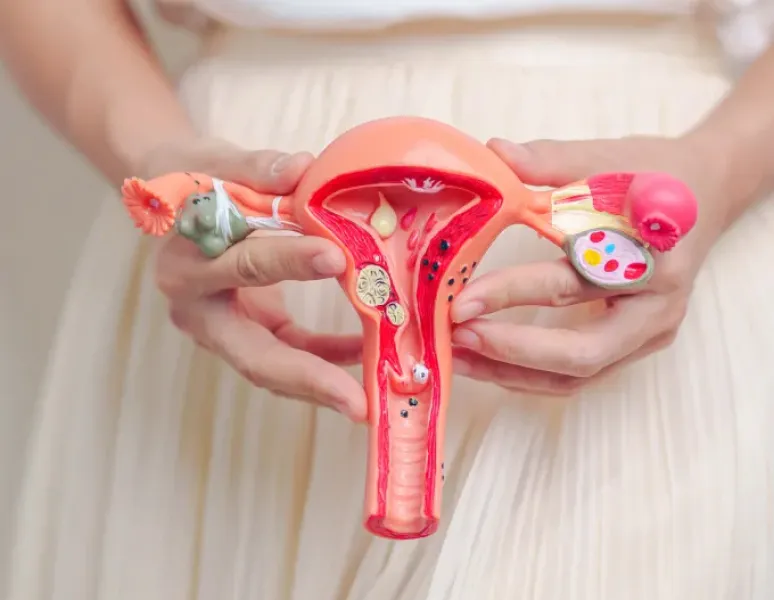
It’s a sad truth that the society we live in doesn’t acknowledge or understand the pain experienced by people who are assigned female at birth — especially those who are also people of color. Whether the pain is just not believed or vastly undertreated, it’s very rarely given the time and attention it deserves. Pain related to Polyendocrine Metabolic Ovarian Syndrome (formerly polycystic ovary syndrome or PMOS) is no exception.
As one participant in a 2019 study published in Health Psychology Open described it, their PMOS is “invisible on the outside yet still visible in the eyes at times. Mental pain. Physical pain. Existential pain.”
Although many people with PMOS report experiencing pain, there hasn’t been enough research dedicated to fully understanding why that is. In fact, pain isn’t even part of the diagnostic criteria for PCOS. How is that possible? Blame the lack of research: According to the National Polycystic Ovary Syndrome Association, less than 0.1% of funding goes to PMOS research and support.
What we do know is that the relationship between pain and PMOS is likely multifactorial — and pelvic floor physical therapy is one option for managing that pain.
What is Polyendocrine Metabolic Ovarian Syndrome (PMOS)?
Polyendocrine Metabolic Ovarian Syndrome (formerly polycystic ovary syndrome or PMOS) is a hormonal condition that affects up to 1 in 10 people who are assigned female at birth. Unfortunately, as many as 70% of people with PCOS may not get a formal diagnosis or treatment.
What Are The Symptoms of PMOS?
PMOS can look different from person to person, but common symptoms of the condition include:
- Body hair growth that’s perceived as excessive (hirsutism)
- Acne
- Weight gain
- Infertility caused by irregular ovulation
How Do You Get Diagnosed with PMOS?
The Rotterdam criteria, which is the current standard for diagnosing PMOS, requires that 2 out of 3 of the following be true for diagnosis:
- Longer than normal menstrual cycles (>35 days), or fewer than 8 cycles per year
- High levels of “male” sex hormones (hyperandrogenism) as noted clinically, or through a biochemical analysis
- Polycystic appearing ovaries, as noted using a transvaginal ultrasound
The third condition is where the “polycystic” in PMOS comes from. However, the “cyst” is considered a misnomer because ovarian cysts (more on this later) aren’t necessary or enough to diagnose someone with PMOS. In fact, experts recommended changing the name over a decade ago.
The conditions mentioned in the Rotterdam criteria could also be caused by other health issues, so medical providers will typically collect information on your health history, measure your hormone levels and possibly sugar metabolism, and conduct a pelvic exam to rule out other diagnoses. Ultrasounds may be a part of the process, but not always.
How is PMOS Treated?
Standard treatment for PMOS may include:
- Hormonal and/or blood sugar medications (e.g., birth control, metformin)
- Lifestyle changes (e.g., nutrition, exercise)
- Sometimes surgery in more severe cases (e.g., laparoscopic ovarian drilling)
Pain & PMOS
Although pain isn’t considered a symptom of PMOS, according to Dr. Ashley Rawlins, PT, DPT, a physical therapist and the clinical learning and development lead at Origin, “It is common to see patients with PMOS reporting abdominal pain, pelvic pain, and sexual dysfunction.”
A 2017 study published in Health and Quality of Life Outcomes interviewed 20 people with PMOS and found that symptoms of pain and discomfort came up the most often in their interviews. This highlights the reality that although pain is not a defined symptom of PMOS, it's one that many people with the condition are struggling with day-to-day.
The association between PMOS and pain isn’t totally clear, but there are a couple of ways in which the condition may exacerbate pain and the perception of pain.
PMOS-Related Factors & Pain Perception
Some aspects of the PMOS can increase a person’s perception of pain:
- Low-grade inflammation: PMOS is associated with higher levels of low-grade, chronic inflammation, which can impact pain perception and sensitivity.
- Oxidative stress: Oxidative stress is an imbalance between the level of reactive oxygen species which damage other molecules in the body, and antioxidants which act as defense. People with PMOS have more oxidative stress and may, as a result, have more chronic pain.
- The development of fat cells: PCPMOSOS is associated with increased production of fat cells and weight gain. Fat cells have been positively correlated with pain and inflammation — the more fat cells, the higher the likelihood may be for worsened pain perception.
- Insulin resistance: Insulin resistance happens when the body has more difficulty regulating blood sugar. Many of the symptoms of PMOS make insulin resistance more likely. Insulin resistance is associated with a decreased threshold for pain as well as experiences of chronic pain.
Higher Rates of Chronic Pain Disorders for People with PMOS
“Unfortunately, there isn’t much research out there dedicated to understanding pain and PMOS,” explains Rawlins. “While people with PMOS commonly have pain, it is unclear if this pain is a result of PCOS or if instead, it is correlated with other conditions that are common in those who have PMOS.”
People with PMOS are more likely to have pain-related conditions like migraines, fibromyalgia, irritable bowel syndrome, and rheumatoid arthritis.
The Relationship Between Mental Health & Pain Perception
Research shows that mental health has a bidirectional relationship with pain perception, but the specifics of this relationship aren’t totally clear either.
“It may be that pain develops or is perpetuated for a number of different reasons in those who have PMOS, including alterations in sex hormones, period abnormalities, and psychological disturbances — depression and anxiety for example—which are known to be associated with increased body pain,” says Rawlins. Additionally, “the sexual dissatisfaction that is common in those with PMOS can perpetuate pain due to fear-avoidance behaviors that can enhance pain and muscle tension.”
Ovarian Cysts & Pain
Although the terms “ovarian cysts” and “polycystic ovaries” are frequently used interchangeably, they represent different conditions. Ovarian cysts include a range of fluid or tissue filled masses on the ovaries. The most common type of ovarian cysts are functional cysts, and are asymptomatic and usually resolve on their own. On the other hand, the “cysts” characterized in PMOS are actually immature follicles (aka underdeveloped egg follicles on the ovary that are not able to mature fully).
Not everyone who has PMOS has “polycystic” ovaries either (remember only 2 out of the 3 criteria are necessary for diagnosis according to the Rotterdam criteria), and those who do may or may not have immature follicles that develop into a common kind of ovarian cyst. That said, cysts may be more common in people with PMOS.
8% to 18% of people with the capacity to get pregnant have benign functional cysts, which can be categorized as corpus luteum cysts or follicular cysts. Corpus luteum cysts form when follicles release eggs (meaning every cycle with ovulation) and follicular cysts form if a follicle doesn’t release an egg but continues to grow. Any follicle, including the immature follicles related to PMOS, can develop into follicular cysts.
Functional ovarian cysts often aren’t accompanied by symptoms and typically go away on their own. However, they can sometimes twist or burst, causing dull or sharp pain and pressure in the abdomen.
If someone with PMOS has an immature follicle that becomes so large it twists or bursts, this can contribute to the pain they may experience.
PMOS & Endometriosis
PMOS and endometriosis, which is an inflammatory condition marked by the presence of tissue that’s similar to the lining of the uterus outside of the uterus, are two different issues. However, because they’re both associated with pain, difficult periods, infertility, and chronic inflammation, they’re sometimes mixed up.
Some research points to people with PMOS and pelvic pain or infertility having a higher likelihood of also having endometriosis, while other research positions the conditions as opposite sides of the spectrum of reproductive disorders.
Whether the conditions end up being related or completely opposed, anyone experiencing pelvic pain deserves answers. Pelvic floor physical therapy is one way to get there.
Treating PMOS Pain with Pelvic Floor Physical Therapy
There are four primary ways pelvic floor physical therapists can help people manage PMOS-related pain:
- Optimizing pelvic floor muscle function: Pelvic floor physical therapy “is helpful in optimizing pelvic floor muscle function in those with muscle dysfunction and symptoms related to pelvic pain, or bowel and bladder dysfunction,” Rawlins says.
- Understanding PMOS: “It is helpful to provide general information about PMOS, so that patients can better understand what is going on in their body — and have agency over their treatment and wellness.”
- Learning about the science of pain: “Because bodily pain is common, it is important to provide education on pain — how it develops and is perpetuated by the nervous system — and provide interventions that focus on minimizing pain perception and maximizing pain-free movement.”
- Guiding exercise: “Exercise is an effective intervention for helping to manage PMOS symptoms, and minimizing pain in general.” Additionally, diaphragmatic breathing is a deep-breathing exercise that a pelvic floor physical therapist can add to your toolkit. This form of breathing is a low-barrier way to manage pain and regulate the central nervous system.
How Origin Can Help
Whatever kind of pelvic or chronic pain you’re experiencing, Origin’s team of expertly trained and compassionate pelvic floor physical therapists can help.
Our physical therapists take a whole-human approach to helping you start feeling better as quickly as possible. By combining evidence-based therapy and exercises with holistic education and trauma-informed emotional support, they’re equipped to help you understand what’s happening in your mind and body so you can take steps toward sustainable healing.
Your PT will validate your experience with pain and will work with you to get to the bottom of it. Origin accepts most insurance plans — and we will provide you with a superbill for potential reimbursement or referrals to another trusted therapist if we don’t accept yours. And, if you need another specialist to help you get a formal diagnosis, we can connect you with trusted experts.
Book a visit with Origin today to find out what you need to know to support pain-free living.