
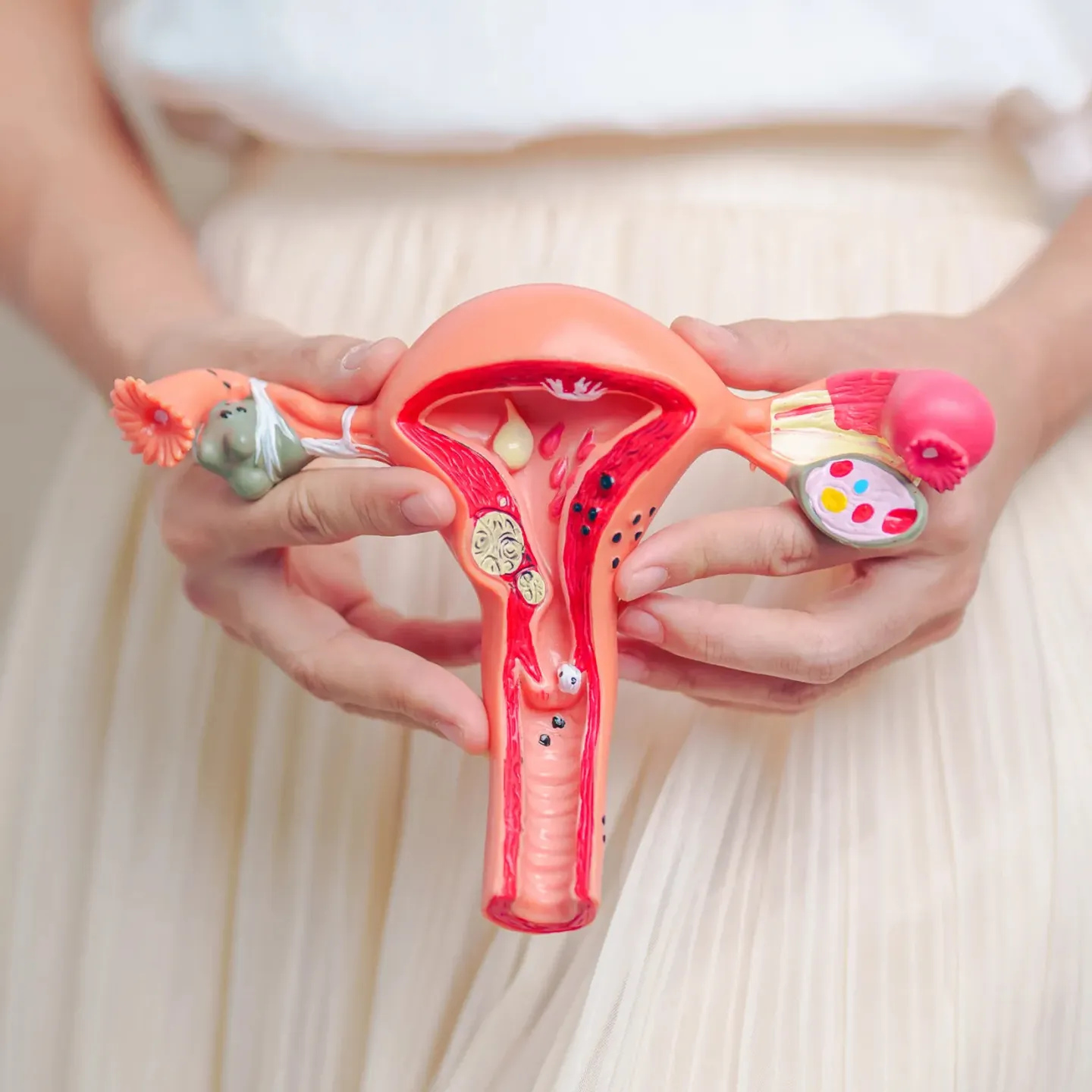
El PCOS tiene un nuevo nombre: síndrome ovárico metabólico poliendocrino (SOMP). El cambio de nombre refleja los efectos generalizados de la condición en la salud hormonal, metabólica y reproductiva, no solo en los ovarios. Si tienes SOMP, la terapia del piso pélvico puede ayudarte a controlar síntomas como dolor pélvico, períodos dolorosos y relaciones sexuales dolorosas.
Puede que hayas escuchado la noticia: el PCOS (síndrome de ovario poliquístico) ¡tiene un nombre nuevo! El 12 de mayo de 2026, un panel internacional de expertos, investigadores, profesionales de la salud y pacientes anunciaron que el PCOS sería oficialmente renombrado como síndrome ovárico metabólico poliendocrino (SOMP).
El nombre SOMP refleja mejor los efectos generalizados de la condición en la salud hormonal, metabólica, reproductiva y general. Sin embargo, aunque el nombre es nuevo, la condición y sus efectos siguen siendo los mismos. Hablemos sobre qué significa este nombre nuevo, por qué cambió y cómo cuidar tu salud si tienes SOMP, sin importar cómo la llames.
¿Qué es el síndrome ovárico metabólico poliendocrino (SOMP)?
El síndrome ovárico metabólico poliendocrino (SOMP), formalmente conocido como PCOS, es una condición compleja relacionada con los sistemas hormonal y metabólico de tu cuerpo.
El nombre anterior, síndrome de ovario poliquístico (PCOS), hacía que los quistes ováricos fueran el enfoque principal de esta condición… aunque los “quistes” en realidad son folículos, y normalmente no son clínicamente significativos. En realidad, el SOMP está asociado con muchas preocupaciones de salud diferentes, incluyendo períodos menstruales irregulares, desafíos de fertilidad, regulación deficiente del azúcar en sangre y dolor crónico.
Independientemente de cómo se llame, el SOMP es el trastorno hormonal más común entre mujeres en edad reproductiva y personas asignadas al nacer como mujeres. Diagnosticar SOMP puede ser complicado, y afecta entre el 5% y el 26% de las mujeres en todo el mundo.
¿Qué significa SOMP?
SOMP significa síndrome ovárico metabólico poliendocrino. ¡Este nombre nuevo es largo y puede ser difícil de entender! Desglosemos qué significa cada término.
- Poliendocrino: “Poli” significa “muchos”, y endocrino se refiere a las partes de tu cuerpo que crean y liberan hormonas (principalmente tejidos y glándulas). Juntos, poliendocrino significa que esta condición involucra múltiples sistemas hormonales, incluyendo hormonas sexuales, insulina y hormonas ováricas.
- Metabólico: Metabólico es la parte más obvia del cambio de nombre, y por buena razón. SOMP no es solo una condición ovárica; es un trastorno metabólico crónico. SOMP está asociado con resistencia a la insulina, enfermedad cardiovascular, diabetes tipo 2 y enfermedad del hígado graso… todos los cuales se pueden controlar y manejar.
- Ovárico: Mantener la palabra “ovárico” en el nombre reconoce que tus ovarios siguen siendo un jugador importante en esta condición… aunque sean solo una parte del complejo sistema hormonal y reproductivo del cuerpo. Ya sea que elijas reproducirte o no, SOMP puede afectar la función de todo tu sistema reproductivo, incluyendo la ovulación, la fertilidad y la regularidad del ciclo menstrual.
- Síndrome: Usar la palabra “síndrome” muestra que SOMP es un grupo de signos y síntomas relacionados con la salud, no una enfermedad clara.
En conjunto, el nombre SOMP define esta condición con mayor precisión que su nombre anterior, PCOS, y refleja cuán ampliamente puede afectar la salud y el bienestar general de las personas con el síndrome.
PCOS → SOMP: ¿Por qué cambió el nombre?
Durante los últimos 11 años, 56 organizaciones académicas, clínicas y de pacientes líderes han trabajado para renombrar PCOS, junto con la opinión de más de 14,000 clínicos y pacientes con PCOS. Estos expertos han argumentado durante mucho tiempo que el término “síndrome de ovario poliquístico” era engañoso.
El nombre antiguo no capturaba el amplio rango de signos y síntomas del SOMP, y hizo que entender y diagnosticar esta condición fuera más difícil. El cambio de PCOS a SOMP no fue un simple cambio de marca, sino un esfuerzo científico internacional de una década para desarrollar un nombre que realmente describa esta condición.
Cómo el nuevo nombre puede ayudar con el diagnóstico de SOMP
El nombre PCOS puede haber afectado cuántas mujeres recibieron un diagnóstico preciso, ya que hasta el 70% de las personas con la condición permanecen sin diagnosticar. ¡Después de todo, llamarlo “síndrome de ovario poliquístico” ciertamente te hace pensar que deben estar involucrados los quistes ováricos!
Sin embargo, los “quistes” ováricos asociados con PCOS son en realidad folículos de óvulos subdesarrollados. Estos folículos pueden afectar tu ovulación y fertilidad, pero no son quistes, y no todas las personas con SOMP los tienen.
Eliminar la palabra “quistes” y enfatizar las partes endocrina y metabólica de esta condición puede alentar a los proveedores de salud a mirar más allá de solo los síntomas reproductivos… ya que muchas personas no reciben un diagnóstico de PCOS hasta que están intentando concebir.
El objetivo de este cambio de nombre es ayudar a:
- Explicar que SOMP involucra síntomas hormonales, metabólicos, psicológicos y dermatológicos (de la piel).
- Eliminar la confusión que rodea la definición de esta condición, lo que puede llevar a retrasos en el diagnóstico.
- Poner a los pacientes y proveedores de salud en la misma página, permitiendo una mejor comunicación y atención.
- Eliminar el enfoque reproductivo y el posible estigma asociado con el nombre “PCOS”.
Cambiar el nombre de esta condición no es una solución completa. Sin embargo, el lenguaje es poderoso, y la claridad es clave. Si ya has recibido un diagnóstico, tu tratamiento y cuidado del PCOS no cambiarán de repente; solo tiene un nombre diferente.
Cómo saber si tienes PCOS, ahora SOMP
Para determinar si tienes SOMP, tu proveedor de salud buscará tres cosas: irregularidad del ciclo menstrual, signos de hormonas de andrógenos elevados y si tus ovarios tienen muchos folículos inmaduros (generalmente 20 o más). Estos signos pueden manifestarse en tu cuerpo de diferentes maneras, y los signos más comunes y síntomas del SOMP incluyen:
- Acné o piel grasa
- Adelgazamiento del cabello o pérdida de cabello
- Períodos irregulares o salteados
- Crecimiento de vello corporal o facial excesivo, llamado hirsutismo
- Aumento de peso o dificultad para perder peso, especialmente alrededor de tu cintura
Algunas personas con PCOS tendrán varios de estos síntomas; otras tendrán solo uno (¡y es posible que ni siquiera se den cuenta!). Esta lista no es exhaustiva, y no está destinada a descartar o confirmar definitivamente el SOMP.
Si estos signos te resultan familiares, comunícate con un proveedor de salud para discutir tus preocupaciones, diagnóstico y opciones de tratamiento.
Dolor por PCOS y salud pélvica
El dolor pélvico crónico y el malestar puede que no estén en la lista de los síntomas más comunes del SOMP, pero eso no significa que no sean muy, muy reales. SOMP puede aumentar tu sensibilidad al dolor y causar inflamación de bajo grado, desregulación hormonal y estrés oxidativo, todo lo cual contribuye al dolor crónico. El dolor por SOMP puede verse así:
- Dolor pélvico
- Cólicos menstruales
- Dolor y calambres abdominales
- Hinchazón
- Sexo doloroso
Trabajar con un fisioterapeuta especializado en el piso pélvico puede ayudarte a manejar y aliviar síntomas de dolor crónico relacionados con SOMP, especialmente en torno al dolor pélvico, períodos dolorosos y sexo doloroso.
Opciones de tratamiento para el SOP / SOMP
La experiencia de cada persona con el SOMP es diferente, así que el tratamiento debe adaptarse a tus síntomas, tus metas y tu salud en general. El cansancio, los cambios de peso, el dolor pélvico, los periodos irregulares, la resistencia a la insulina, la ansiedad y el acné están relacionados con el SOMP; un enfoque integral puede ayudarte a manejar tus síntomas y a cuidar tu cuerpo como un todo.
Los enfoques de tratamiento más comunes incluyen:
- Cambios en el estilo de vida, incluidos cambios en la alimentación, para apoyar la salud metabólica
- Pastillas anticonceptivas hormonales para la regulación hormonal… ¡no solo como método anticonceptivo!
- Ejercicio regular y entrenamiento de fuerza
- Medicamentos GLP-1
- Medicamentos como la metformina para quienes tienen resistencia a la insulina
- Fisioterapia para el manejo del dolor y la función del cuerpo
¿La fisioterapia de piso pélvico puede ayudar con el SOMP?
¡Sí! Las personas con SOMP pueden tener más probabilidades de tener los músculos del piso pélvico tensos, y un fisioterapeuta de piso pélvico puede ayudarte tanto a fortalecer como a alargar esos músculos. También puedes trabajar con tu fisioterapeuta para romper la vía del dolor entre tu cerebro y tu piso pélvico, lo que ayuda a reducir síntomas como los periodos dolorosos, el sexo doloroso y el dolor pélvico.
Usar el nombre SOMP en lugar de SOP puede requerir algo de adaptación. Sin embargo, este cambio de nombre nos ayuda a reconocer que esta afección va mucho más allá de los ovarios y merece un enfoque de atención más amplio e integral. Si estás lista para formar un equipo de atención para el SOMP que apoye la salud de todo tu cuerpo, nuestros fisioterapeutas de piso pélvico están aquí para ayudarte. Comunícate con nosotros hoy para reservar una cita con nuestro equipo.
- Gao, Xueying, et al. "Data-Driven Subtypes of Polycystic Ovary Syndrome and Their Association with Clinical Outcomes." Nature Medicine, 29 Oct. 2025, pp. 1–11, www.nature.com/articles/s41591-025-03984-1, https://doi.org/10.1038/s41591-025-03984-1
- Khodavirdilou, Lida, and Jenny L. Wilkerson. "Pain in Polycystic Ovary Syndrome: A Comprehensive Bedside to Bench Perspective on an Underrecognized Symptom." Frontiers in Pharmacology, vol. 16, 13 Jan. 2026, pmc.ncbi.nlm.nih.gov/articles/PMC12835408/, https://doi.org/10.3389/fphar.2025.1670766
- Shukla, Anukrati. "Polyendocrine Metabolic Ovarian Syndrome." StatPearls [Internet]., U.S. National Library of Medicine, 7 July 2025, www.ncbi.nlm.nih.gov/books/NBK459251
- Teede, Helena J, et al. "Polyendocrine Metabolic Ovarian Syndrome, the New Name for Polycystic Ovary Syndrome: A Multistep Global Consensus Process." The Lancet, vol. 0, no. 0, 2026, www.thelancet.com/journals/lancet/article/PIIS0140-6736(26)00717-8/fulltext, https://doi.org/10.1016/S0140-6736(26)00717-8
- Fernandez, Renae C, et al. "Diagnosis Delayed: Health Profile Differences between Women with Undiagnosed Polycystic Ovary Syndrome and Those with a Clinical Diagnosis by Age 35 Years." Human Reproduction, vol. 36, no. 8, 8 May 2021, https://doi.org/10.1093/humrep/deab101
- Keen, MohammadAbid, et al. "Cutaneous Manifestations of Polycystic Ovary Syndrome: A Cross-Sectional Clinical Study." Indian Dermatology Online Journal, vol. 8, no. 2, 2017, p. 104, https://doi.org/10.4103/2229-5178.202275
- Lentscher, Jessica, and Alan DeCherney. "Clinical Presentation and Diagnosis of Polycystic Ovarian Syndrome." Clinical Obstetrics & Gynecology, vol. 64, no. 1, 21 July 2020, pmc.ncbi.nlm.nih.gov/articles/PMC10683967/, https://doi.org/10.1097/grf.0000000000000563