

If the thought of pregnancy, labor, and delivery makes you anxious, you aren’t alone. Many pregnant people experience fear of giving birth.
These fears are common and valid, but fortunately, there are evidence-based solutions that can help. Let’s explore where the fear of childbirth comes from, how it can impact pregnancy and birth outcomes, and most importantly, what you can do to feel more prepared and in control.
One particularly powerful tool is prenatal pelvic physical therapy, which addresses both the physical preparation your body needs and the mind-body connection that builds confidence.
How does the fear of giving birth show up?
Like many fears, fear of childbirth exists on a spectrum from low to high severity.
At the milder end, you might experience common worries about pain during labor and delivery, the unknown, or changes to your body. After all, your body and life are changing rapidly during pregnancy: it’s perfectly understandable that these worries would arise!
If these fears intensify, however, they can cause significant anxiety that impacts your pregnancy experience. You might find yourself constantly worrying, avoiding thoughts or conversations about birth, or feeling distressed when thinking about labor and delivery.
The most severe cases manifest as tokophobia, an extreme phobia of pregnancy and childbirth that can feel completely overwhelming.
What is tokophobia?
The medical literature defines tokophobia as “pathologically high levels of childbirth fear”. While the exact criteria for tokophobia aren’t well defined, most research emphasizes that tokophobia is a clinical, phobic condition that goes well beyond typical concerns.
People with tokophobia experience extreme fear and may engage in avoidance behaviors typical of other phobias. These might include:
- Taking great pains to prevent pregnancy
- Requesting a C-section specifically to avoid vaginal birth
- Experiencing severe anxiety when thinking about childbirth
What is the difference between anxiety and tokophobia?
According to the American Psychological Association, anxiety is an emotion that involves apprehension about some potential future event. It often includes physical bodily symptoms such as increased muscle tension and faster breathing and heart rate.
You may feel anxiety about any number of things, from an upcoming presentation at work to a big social event. It makes perfect sense that anxiety and childbirth go hand-in-hand for many pregnant people: you have 9 months to think about it, after all!
General anxiety about childbirth might cause some periodic worrying, but tokophobia is much more severe. If untreated, it can significantly impact your mental health and even your pregnancy outcomes.
How common are tokophobia and fear of childbirth?
The average rates of these fears vary by the population studied, but research from Egypt suggests that:
- Approximately 14-22% of pregnant people experience significant fear of childbirth.
- About 6-10% have severe tokophobia.
A study from the US found rates of tokophobia spiked to 62% during the COVID-19 pandemic.
These numbers are an important reminder if you’re feeling scared of childbirth: you're not alone in these emotions.
Why is it important to address the fear of giving birth?
Fear of childbirth is more than an emotional experience: It can cause real complications during pregnancy.
Significant fear of giving birth may increase the pain you feel during labor and delivery. It can also prolong the first and second stages of labor, and it may cause you to feel very dissatisfied with your labor and birth experience.
For example, a US-based study of pregnancies during the Covid-19 pandemic found an association between tokophobia and increased odds of preterm birth. Compared to those without tokophobia, birthing people with tokophobia had nearly double the risk of delivering their babies early.
These stats aren’t meant to scare you: instead, we’re sharing them to illustrate the impact of untreated tokophobia on both birthing people and their babies. At Origin, we believe that knowledge is power for our patients. We want you to understand potential concerns so you can take proactive steps to support your health.
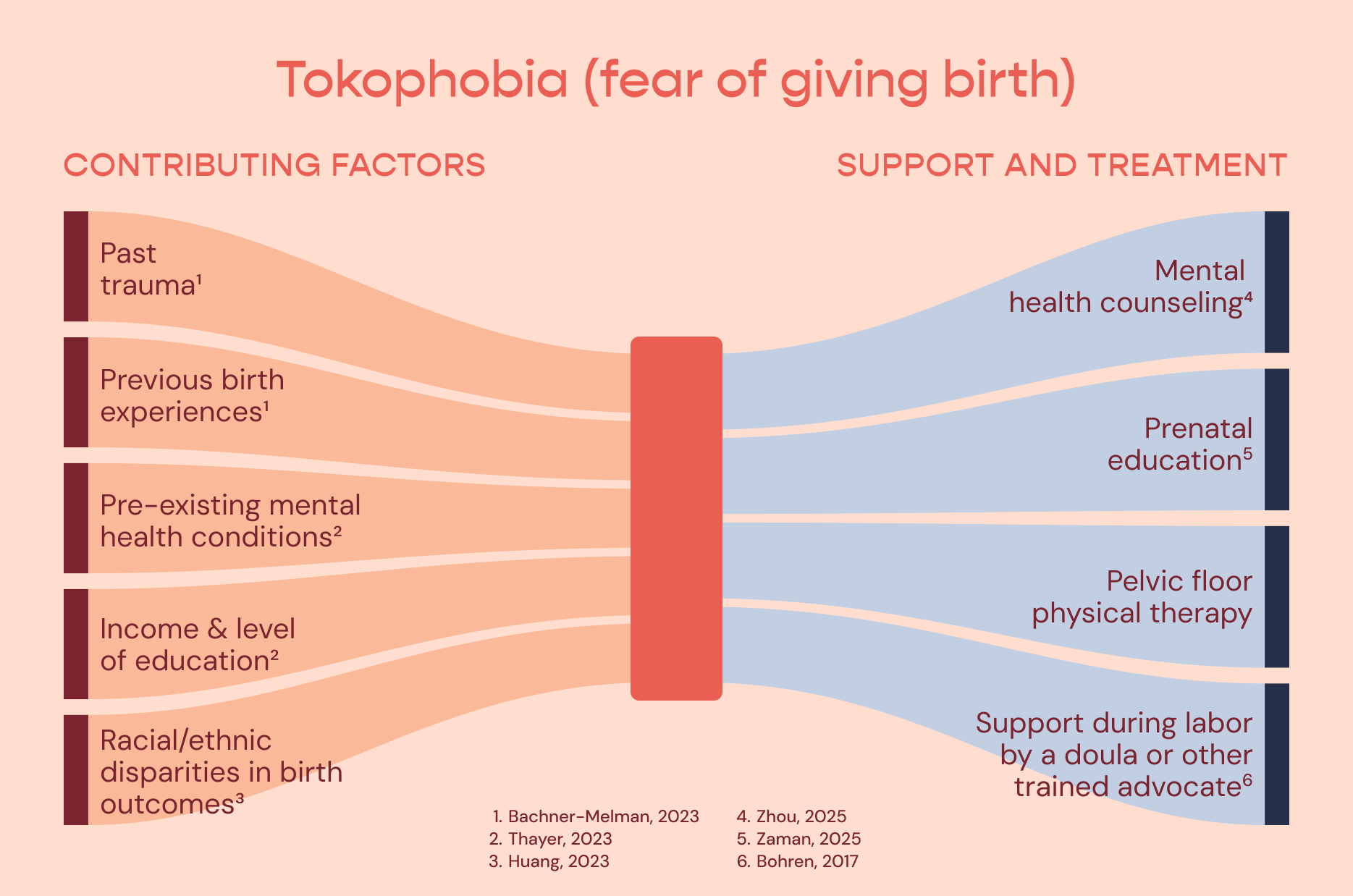
What contributes to the fear of giving birth?
If you’re feeling scared of childbirth, it can help to understand the possible origins of that fear. This lets you have compassion for yourself and your feelings and find the right support.
Personal and medical history
Past trauma can strongly influence the birth experience. For example, people who experienced physical or sexual abuse as children show significantly higher scores on fear of childbirth scales. Birthing people who have experienced sexual trauma in the past are also more likely to experience childbirth as traumatic.
Previous birth experiences can also impact how you feel about subsequent pregnancies. Childbirth causes post-traumatic stress disorder (PTSD) in approximately 3-4% of all birthing people, with higher rates in high-risk groups. If you already have post-traumatic symptoms from any source, pregnancy and childbirth can heighten those symptoms.
Pre-existing mental health conditions also show strong connections to tokophobia. For example, people with prenatal depression have nearly five times higher odds of experiencing tokophobia compared to those without depression.
People with lower income and less education also experience higher rates of tokophobia than the general population.
Inequities and discrimination in healthcare
Discrimination and lack of equity in obstetric care contribute to different pregnancy and delivery outcomes across groups. These differences can contribute to a phobia of pregnancy and childbirth in people from marginalized groups.
National statistics data from across the United States paint a sobering picture of the racial disparities in maternity outcomes. Over a 20-year period from 2000 to 2019, maternal mortality rates have increased in the United States, even as they've decreased in other high-income countries.
However, maternal mortality isn’t evenly distributed across the population. The racial disparities are particularly stark and unacceptable:
- Black birthing people face a maternal mortality risk 2.13 times higher than their White peers. Among Native American birthing people, the maternal mortality risk is 2.02 times higher than in White counterparts.
- Non-White birthing folks also experience significantly higher rates of C-sections and serious complications such as severe perineal tears and ICU admission.
If you're part of one of these communities and feel scared of childbirth, be compassionate with yourself. When your community faces measurably higher risks, worse treatment, and poorer outcomes in obstetric care, fear is a normal, human response.
This fear reflects the reality of healthcare inequities that desperately need to change. It’s essential to acknowledge your feelings while also seeking supportive, culturally competent providers who will prioritize your wellbeing.
At Origin, we take great pride in offering the highest level of culturally competent care for our pregnant and postpartum patients. If you’re ready to work with a provider who understands and supports your unique needs, we’re ready to help.
What kinds of tokophobia therapy can help?
The fear of giving birth can feel overwhelming. Fortunately, there are many effective approaches for addressing tokophobia and related fears.
Psychological support and education
The research supports mental health counseling as a powerful form of tokophobia therapy. A comprehensive review over 3,000 pregnant people found that cognitive behavioral therapy, motivational interviewing, and other counseling approaches provided before birth all significantly reduced fear of childbirth.
These techniques can be effective whether you receive them in person or virtually. A 2025 study in Egypt used WhatsApp to offer cognitive restructuring, exposure therapy, relaxation techniques, and education to pregnant women with tokophobia. This digital program significantly reduced fear and increased self-efficacy in the participants.
Origin recognizes the importance of mental health for improving overall health outcomes. We’ve partnered with Seven Starling and Mavida to provide simple, cost-effective mental healthcare options for Origin patients.
Prenatal education can also make a measurable difference in childbirth fear. A 2025 study involving over 1,000 pregnant people showed that prenatal education significantly decreased their fear and increased their sense of self-efficacy about birth. This education even impacted delivery outcomes, leading to higher rates of vaginal delivery and lower rates of cesarean sections.
Continuous labor support can improve your birthing experience and outcomes. This involves having an advocate such as a doula or a trained partner present to support you throughout the entire labor and delivery process.
Continuous labor support appears to increase your likelihood of vaginal birth without the need for additional interventions such as forceps or a C-section. It may also shorten the length of your labor, reduce how much pain medication you need, and lead to greater satisfaction with your labor experience.
Your Origin provider can help connect you with doulas and other support resources as part of a comprehensive approach to preparing for childbirth.
How can pelvic physical therapy help you prepare to give birth?
When you’re preparing for birth, pelvic physical therapy offers something unique: it provides both the physical preparation your body needs and the nervous system regulation and body awareness that build true confidence. This combo can be game-changing, especially for people with tokophobia.
Can pelvic floor therapy help with fear of childbirth?
Yes! Pelvic physical therapy can help you take back control of your body during a time of great change, and it can improve your labor outcomes and recovery.
Research on prenatal pelvic health physical therapy shows multiple physical benefits, including:
- Reduced labor time
- Lower incidence of perineal trauma (vaginal tears during delivery)
- Increased awareness and strength of the pelvic floor muscles
- Decreased postpartum urinary incontinence
Pelvic physical therapy is both safe and effective for optimizing vaginal delivery outcomes. It can help humanize the delivery process, from preparation to postpartum recovery.
How does pelvic physical therapy affect the mind-body connection?
Pelvic PT offers more than just physical preparation. It helps you build a powerful mind-body connection so you’re better able to face your fears. Your pelvic physical therapist may employ several techniques to help you connect your mind and body.
Body awareness training
Research on body awareness therapy shows that it helps people become in better contact with their "bodily self". It can improve your stability, balance, grounding, and relaxation capacity.
When applied in pelvic health, body awareness training can help you connect with your pelvic floor and understand how your body works. This connection can help you build genuine confidence in your body's capabilities.
Nervous system regulation
Your pelvic PT can teach you techniques to help you move from a fight-or-flight stress response to a calmer, more grounded state. This can help you feel more in control of your physical and emotional responses, particularly during stressful events such as childbirth.
Proactive preparation
When you take tangible action to prepare your body for childbirth, you can reduce feelings of helplessness. Instead of passively waiting for birth to happen to you, you're actively doing something to get ready.
Preparation can enhance your self-efficacy, the sense that "my body can do this, and I have tools to help." Building pelvic floor strength and awareness, learning breathing and relaxation techniques, and understanding the mechanics of birth can all help you build your sense of your own strength and capability.
A supportive care relationship
Prenatal pelvic physical therapy also creates a safe, supportive relationship where you can share your fears and concerns and feel validated. Your Origin PT can help you build a birth preparation plan that fits your specific needs and connect you with other providers who can help.
How to start tackling tokophobia
You don't have to navigate childbirth fears alone. Whether your birth anxiety is mild or you're experiencing severe tokophobia, you have access to effective support.
Taking charge of what you can control (your birth plan, your support team, your body awareness) can help reduce fear and increase confidence as you approach delivery day. Your feelings are valid, and your birth experience matters. You deserve supportive, respectful care that honors your concerns and leans into your strengths.
Schedule your first visit with an Origin clinician, and start tackling tokophobia today.