GLP-1 medications have changed how weight loss works for millions of people. They’re also increasingly popular for the management of other conditions ranging from type II diabetes and polycystic ovary syndrome (PCOS) to liver disease and substance use disorders. They work well for many who’ve struggled to control these conditions… but they still aren’t a miracle cure.
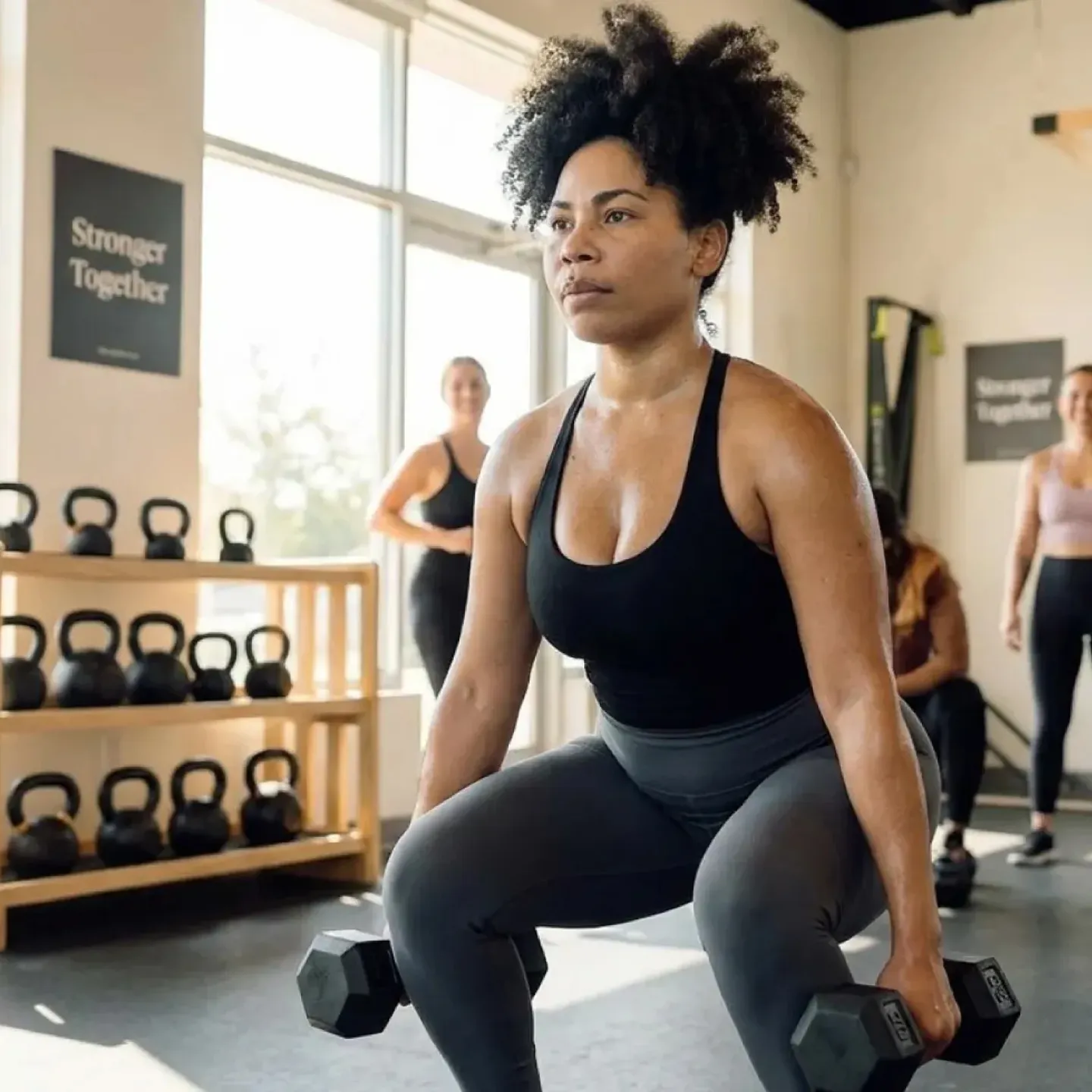
As with most pharmaceuticals, GLP-1 medications can cause side effects. In the musculoskeletal system, these side effects include the loss of lean muscle mass alongside fat loss. This is why strength training is such a critical component of care if you’re using GLP-1s: it can help you maintain muscle mass and adapt to your changing body.
Let’s talk about how you can strength train effectively and safely on GLP-1s to support your overall wellbeing and your pelvic health.
How do GLP-1 medications affect muscle mass?
When you lose weight on GLP-1 medications, not all of that weight change comes from fat loss: the medications don’t just target fat cells. Some of the weight loss they cause comes from the loss of lean mass, which includes muscle.
A large study from 2025 reviewed data from over 2,200 research participants using GLP-1s. On average, about 25% of the total weight these individuals lost came from lean mass. That’s a pretty big percentage!
Keep in mind that the medical research on GLP-1s is still in its infancy. There’s a lot of variation between the studies that have estimated lean mass loss during GLP-1 use. Some of this variation is likely due to different study techniques, populations, and timelines.
An important nuance to consider: early data suggests that the muscle loss that results from GLP-1 use may not be all bad. Although your total muscle volume may decrease while you’re taking GLP-1 medications, muscle quality tends to improve.
After GLP-1-driven weight loss, you may have less fat infiltration into your muscles. This change in composition, alongside improved insulin sensitivity, helps your remaining muscles function better than they previously did. In essence, the muscles are adapting to weight loss by shrinking and becoming more efficient.
There are also meaningful differences in lean mass loss based on the specific GLP-1 medications in use. In that same 2025 study:
- Liraglutide was the only GLP-1 that significantly reduced weight without also significantly reducing lean mass.
- Semaglutide and tirzepatide most effectively reduced total weight and fat mass, but they were also the least effective at preserving lean mass.
Regardless of the type or dosage of GLP-1 you take, muscle loss will likely be a real concern. Fortunately, you can learn how to lose weight and maintain muscle at the same time.
How to maintain muscle while losing weight
No big surprises here: Resistance training is the most evidence-supported tool for muscle preservation during all types of weight loss. This applies to people of all sexes and ages, including older adults: you’re never too old to start strength training!
For people on GLP-1s, physical activity plays a direct role in maintaining muscle function. As an added bonus, exercise also helps improve the insulin sensitivity of your muscles: basically, it helps them use sugars from food more efficiently.
While potentially positive muscle adaptations from GLP-1 use can offset some effects of losing muscle volume, they don’t negate the need for strength training. Let’s talk about how you can safely start or continue lifting weights to promote muscle retention while using GLP-1s.
Is weightlifting bad for pelvic floor health?
Nope! Your pelvic floor shouldn’t hold you back from resistance training while on GLP-1s. Many people still worry that lifting weights, especially heavy ones, will cause or worsen pelvic floor problems such as bladder leaks or prolapse.
This is an understandable concern: certain exercise activities, including running and jumping, increase the pressure inside the abdomen. Increased internal pressure makes your pelvic floor work harder to support your pelvic organs and prevent leaks.
However, not all intra-abdominal pressure (IAP) is created equal. Maximal IAP is actually greater when you stand up from a chair than it is during many strengthening exercises, including abdominal crunches and stair climbing. Coughing increases IAP more than most traditional weight lifting movements.
What more proof that weight training won’t make you start peeing your pants overnight?
A 2021 study from Norway specifically recruited previously inactive, overweight women to begin strength training. Before they started training, about one-third of participants were already living with urinary incontinence. After 3 months of strength training, there was no significant increase in incontinence symptoms among the weightlifting participants. We call that a win for resistance training!
How do you lift weights properly to protect your pelvic floor?
Now you know that resistance training is a safe, effective method of muscle preservation during GLP-1 use, and it won’t automatically cause pelvic floor problems.
However, this doesn’t mean you can start flinging weights around willy-nilly and get away scot-free. The type and frequency of the exercises you choose, as well as your form and the amount of weight you use, can have a real impact on your pelvic floor. This is particularly important to remember if you’re new to strength training or returning after a long break.
Side note: If you’ve already started weightlifting and you’re noticing new symptoms such as urinary leakage, don’t panic. Simply getting active again or starting a new type of exercise can challenge the pelvic floor in new ways. For some people, these new challenges can unmask pelvic floor problems that were already present but flying under the radar. Fortunately, pelvic physical therapy can help address these symptoms so you continue weightlifting confidently.
If you’ve been wondering, “Are squats bad for pelvic floor health?” or “How can I lift heavy weights without hurting my pelvic floor?”, we’ve got you. Origin clinicians are experts in safe resistance training for people of all ages, sizes, and backgrounds, including those using GLP-1s.
Proper breathing patterns and movement mechanics can reduce increased pressure on the pelvic floor during lifting. Exercises to strengthen pelvic floor muscles and improve their coordination can also help you support your pelvic organs and reduce symptoms during weightlifting.
This is where pelvic floor physical therapy really shines. A pelvic physical therapist can assess how you breath and move during your training routine and help you make adjustments to reduce leakage or other symptoms. Your PT can also guide you on how to properly begin and progress a weightlifting program if you don’t know where to start.
Will losing weight fix my pelvic floor problems?
If you live with pelvic floor symptoms and excess weight, chances are high that a healthcare provider (or several…) has told you that losing weight will fix your pelvic floor problems (sigh). Let’s do a bit of mythbusting by considering what the medical research tells us about this.
A large analysis from 2021 reviewed 33 studies involving more than 5,600 female participants across 20 countries: that’s a lot of data! Across the board, weight loss (from surgery or behavioral changes) significantly reduced urinary incontinence symptoms.
An earlier study from 2017 examined what actually changes in the pelvic floor after significant weight loss from bariatric surgery. The researchers saw that after weight loss, the “neck” of the bladder (where it narrows to become the urethra) sat up higher in the pelvis. This is positive anatomical change that reduces one’s susceptibility to bladder leaks and other problems.
This all sounds like weight loss is the magic bullet for your pelvic floor, right?
Not quite. This same 2017 study found no significant change in the tone and strength of the deep pelvic floor muscles that support the pelvic organs. They also detected no change in urethral hypermobility, a known risk factor for stress urinary incontinence.
This suggests that the improvement in continence we often see after weight loss is likely due to decreased pressure on the bladder. Less body weight means less constant downward pressure, and that alone improves symptoms for some people. However, the underlying functional issues, such as weak or poorly coordinated pelvic floor muscles, are still there (possibly causing persistent symptoms).
We don’t yet have data on the effect of GLP-1s specifically for pelvic health outcomes, so the evidence from studies on bariatric surgery are the closest approximation we have. Because GLP-1s cause fairly rapid weight loss, much like surgery, it’s likely that the outcomes will be similar.
Weight loss can address one contributor to pelvic health problems, but it can’t retrain your pelvic muscles, restore their coordination, or correct other structural mobility issues. Those all require targeted treatment, just like the kind Origin clinicians provide every day.
Remember: while weight loss certainly can help your pelvic floor, it’s rarely a complete solution on its own. Combining weight loss with pelvic health physical therapy may be where the real magic lies.
Why combining weight lifting and pelvic floor training works
Hopefully, you can now appreciate the importance of full-body strength training and pelvic floor treatment during medication-assisted weight loss. So what happens if you combine these two techniques?
You guessed it: resistance training and pelvic floor exercise are a dream team! Regardless of your age or baseline fitness, combining these two powerhouses will pay off. For example:
- Women over 60 who added weightlifting to a pelvic floor exercise program saw quicker improvement in their bladder leaks than those who only did pelvic floor exercises.
- People assigned female at birth frequently experience urinary leakage during high-impact exercise. Fortunately, pelvic floor training can help a LOT. CrossFit enthusiasts who added pelvic floor exercises to their training had significantly less leakage than their classmates who weren’t training their pelvic floors.
Protecting your muscles and your pelvic health
For many people, GLP-1 medications are an effective tool for weight loss. Strength training can help with muscle preservation during significant weight loss from GLP-1 use. Contrary to popular myths, lifting weights is not harmful to your pelvic floor (provided you’re doing so at a level appropriate for you).
If you’re strength training while on GLP-1s, pelvic health physical therapy can be a practical, evidence-based complement to your exercise program. If you’re ready to address new or pre-existing pelvic symptoms and build confidence in your strengthening routine at the same time, our clinicians are ready for you: book your first visit here.
- Bø, Kari et al. "Does regular strength training cause urinary incontinence in overweight inactive women? A randomized controlled trial." International urogynecology journal vol. 32,10 (2021): 2827-2834. doi:10.1007/s00192-021-04739-5
- Bø, Kari, and Ingrid Elisabeth Nygaard. "Is Physical Activity Good or Bad for the Female Pelvic Floor? A Narrative Review." Sports medicine (Auckland, N.Z.) vol. 50,3 (2020): 471-484. doi:10.1007/s40279-019-01243-1
- Govindasamy, Karuppasamy et al. "Effects of Resistance Training on Sarcopenia Risk Among Healthy Older Adults: A Scoping Review of Physiological Mechanisms." Life (Basel, Switzerland) vol. 15,5 688. 23 Apr. 2025, doi:10.3390/life15050688
- Karakasis, Paschalis et al. "Effect of glucagon-like peptide-1 receptor agonists and co-agonists on body composition: Systematic review and network meta-analysis." Metabolism: clinical and experimental vol. 164 (2025): 156113. doi:10.1016/j.metabol.2024.156113
- Linge, Jennifer et al. "Muscle Mass and Glucagon-Like Peptide-1 Receptor Agonists: Adaptive or Maladaptive Response to Weight Loss?." Circulation vol. 150,16 (2024): 1288-1298. doi:10.1161/CIRCULATIONAHA.124.067676
- Moiz, Areesha et al. "The expanding role of GLP-1 receptor agonists: a narrative review of current evidence and future directions." EClinicalMedicine vol. 86 103363. 17 Jul. 2025, doi:10.1016/j.eclinm.2025.103363
- Neeland, Ian J et al. "Changes in lean body mass with glucagon-like peptide-1-based therapies and mitigation strategies." Diabetes, obesity & metabolism vol. 26 Suppl 4 (2024): 16-27. doi:10.1111/dom.15728
- Pomian, Andrzej et al. "Is Bariatric Surgery a Prophylaxis for Pelvic Floor Disorders?." Obesity surgery vol. 28,6 (2018): 1653-1658. doi:10.1007/s11695-017-3067-x
- Sheridan, William et al. "Weight loss with bariatric surgery or behaviour modification and the impact on female obesity-related urine incontinence: A comprehensive systematic review and meta-analysis." Clinical obesity vol. 11,4 (2021): e12450. doi:10.1111/cob.12450
- Skaug, Kristina Lindquist et al. "Pelvic floor muscle training in female functional fitness exercisers: an assessor-blinded randomised controlled trial." British journal of sports medicine vol. 58,9 486-493. 25 Apr. 2024, doi:10.1136/bjsports-2023-107365
- Virtuoso, Janeisa Franck et al. "Effect of Weight Training with Pelvic Floor Muscle Training in Elderly Women with Urinary Incontinence." Research quarterly for exercise and sport vol. 90,2 (2019): 141-150. doi:10.1080/02701367.2019.1571674